
Professional news broadcasts demand exceptional lighting quality. Every news anchor, presenter, guest, and studio set must appear clear, natural, and consistent on camera regardless of the time of day or the duration of the broadcast. Unlike theatrical or entertainment lighting, news studio lighting focuses on accuracy, reliability, and visual consistency rather than dramatic effects.
Modern news studios rely on advanced LED lighting systems, precise lighting design, and intelligent control technology to maintain flawless illumination throughout every broadcast. From local television stations to international news networks, the principles remain largely the same.
In this guide, we’ll explore how news studios achieve perfect lighting, the equipment they use, and the best practices that ensure professional broadcast-quality results.
Why Lighting Is Critical in News Broadcasting
Lighting directly affects how viewers perceive presenters and the overall professionalism of a broadcast.
Poor lighting can result in:
- Uneven skin tones
- Harsh facial shadows
- Inconsistent color reproduction
- Reflections on desks and monitors
- Camera exposure issues
- Viewer distraction
Professional lighting ensures every broadcast looks polished, credible, and visually consistent.
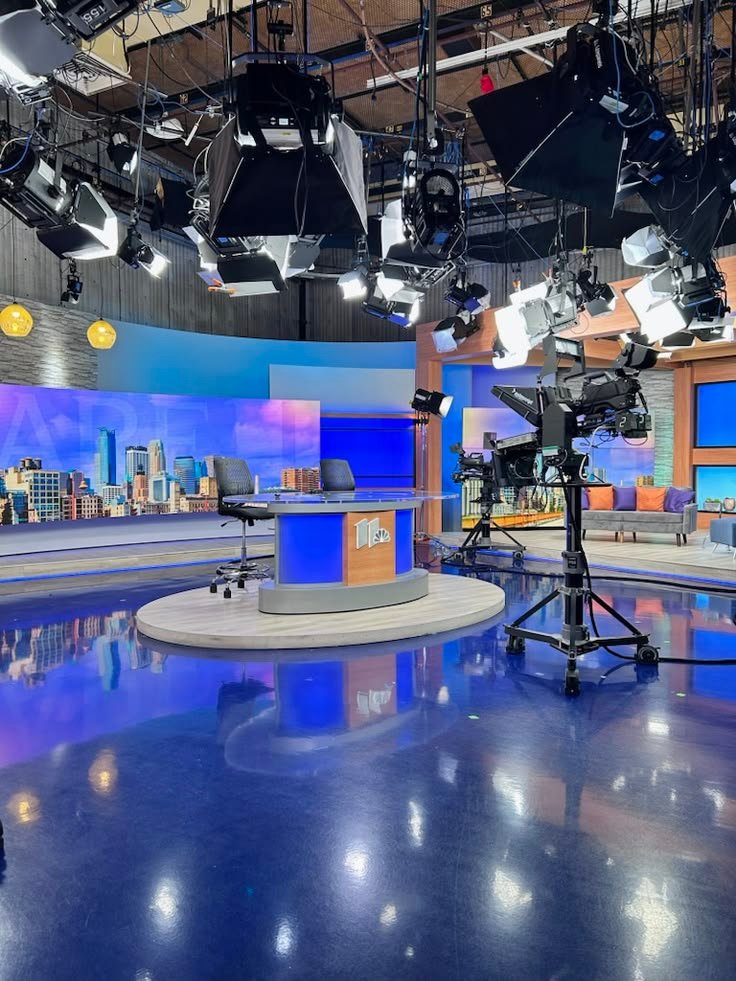
Key Objectives of News Studio Lighting
Unlike entertainment lighting, news studios prioritize:
- Consistent illumination
- Accurate skin tones
- Balanced contrast
- Flicker-free operation
- Natural-looking shadows
- Reliable performance
- Camera-friendly color accuracy
The goal is to create a comfortable viewing experience while maintaining a professional appearance.
Essential Lighting Fixtures Used in News Studios
LED Flat Panel Lights
LED flat panel lights provide soft, even illumination across presenters and studio sets.
They are commonly used for:
- Key lighting
- Fill lighting
- Interview areas
- Presentation zones
Their broad beam helps eliminate harsh shadows while maintaining natural facial features.
LED Fresnel Lights
LED Fresnel fixtures deliver adjustable beam angles for precise key lighting and controlled highlights.
They are ideal for:
- Presenter lighting
- Accent lighting
- Studio feature areas
Soft LED Panels
Soft LED panels create flattering illumination that minimizes facial imperfections and produces comfortable lighting for long broadcasts.
RGBAL LED Fixtures
Many modern broadcast studios now use RGBAL lighting because it offers:
- Superior white light
- Wide color gamut
- Adjustable color temperature
- Excellent color consistency
- High camera performance
Three-Point Lighting for News Anchors
Most professional news studios use a refined version of the traditional three-point lighting setup.
Key Light
The primary light source that illuminates the presenter evenly.
Fill Light
Reduces shadows without flattening facial features.
Back Light (Hair Light)
Separates the presenter from the background and creates depth.
This setup ensures presenters remain well-lit from every camera angle.
High Color Accuracy
Broadcast cameras demand exceptional color fidelity.
Professional news studios typically use fixtures with:
- CRI 95+
- High TLCI ratings
- Stable color output
- Consistent white balance
These features ensure natural skin tones and accurate reproduction of clothing, graphics, and studio elements.
Adjustable Color Temperature
Most news studios operate using daylight-balanced lighting around 5600K, although some productions use adjustable fixtures for different programming formats.
Consistent color temperature ensures seamless matching between multiple cameras and lighting fixtures.
Flicker-Free Performance
Broadcast cameras often operate at different frame rates and shutter speeds.
Professional LED fixtures provide flicker-free performance to eliminate visible flicker or banding during:
- Live broadcasts
- Slow-motion playback
- High-frame-rate recording
- Studio interviews
Controlling Reflections
Modern news studios contain glossy desks, large displays, LED video walls, and glass surfaces.
Lighting designers carefully position fixtures to minimize:
- Screen reflections
- Desk glare
- Eyeglass reflections
- Hot spots on polished surfaces
Proper beam control improves both image quality and viewer comfort.
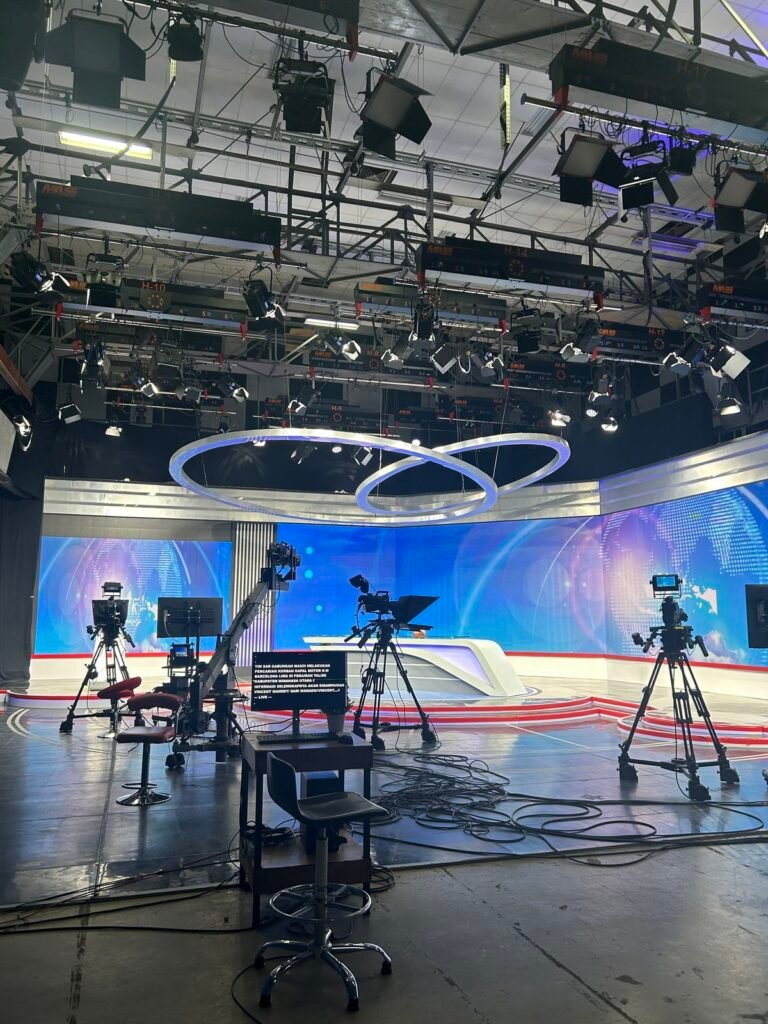
Intelligent Lighting Control
Professional studios use advanced control systems such as:
- DMX512
- Art-Net
- sACN
- Lighting consoles
- Centralized studio automation
These systems allow operators to store lighting presets for different programs and switch between setups instantly.
Energy Efficiency and Reliability
Modern LED lighting provides several operational benefits for news studios:
- Lower energy consumption
- Reduced heat output
- Long operating life
- Minimal maintenance
- Consistent brightness over time
These advantages reduce operating costs while maintaining broadcast-quality performance.
Common Lighting Mistakes to Avoid
Professional broadcast engineers avoid:
- Uneven lighting between cameras
- Harsh overhead lighting
- Mixed color temperatures
- Low-CRI fixtures
- Incorrect fill light levels
- Overexposed backgrounds
- Poor subject separation
Attention to detail ensures every broadcast maintains a consistent visual standard.
Future Trends in News Studio Lighting
Broadcast lighting continues to evolve with technologies such as:
- AI-assisted lighting adjustment
- Automated exposure balancing
- Intelligent scene presets
- RGBAL lighting systems
- Remote lighting management
- Virtual production integration
These innovations improve efficiency while maintaining exceptional image quality.
Frequently Asked Questions
What lights do professional news studios use?
Most news studios use LED flat panel lights, soft LED panels, Fresnel lights, and RGBAL fixtures because they provide soft, accurate, and flicker-free illumination.
Why is CRI important in broadcast lighting?
High CRI ensures that skin tones, clothing, and studio colors appear natural and accurate on camera.
What color temperature do news studios use?
Most broadcast studios use daylight-balanced lighting around 5600K, although adjustable fixtures allow flexibility for different production needs.
Why is flicker-free lighting important?
Flicker-free fixtures prevent visible flicker and banding when filming with professional broadcast cameras at different frame rates.
Do news studios use three-point lighting?
Yes. Nearly all professional news studios use a three-point lighting setup consisting of a key light, fill light, and back light to create balanced, natural-looking illumination.
Conclusion
Perfect lighting is one of the foundations of professional news broadcasting. By combining high-quality LED fixtures, accurate color reproduction, balanced three-point lighting, flicker-free performance, and intelligent control systems, news studios create consistent, natural-looking images that viewers can trust.
Whether you’re designing a television news set, broadcast studio, corporate newsroom, or online news production space, investing in professional lighting equipment and following proven broadcast lighting principles will ensure reliable, high-quality results for every production.