
Touring concert productions are among the most complex lighting projects in the entertainment industry. Unlike permanent venue installations, touring lighting systems must deliver spectacular visual performances while remaining portable, reliable, and quick to assemble and dismantle. Every fixture, cable, truss, and control system is carefully selected to withstand constant transportation and perform consistently in different venues around the world.
From arena tours and stadium concerts to international music festivals, professional touring productions rely on intelligent lighting systems, advanced control networks, and meticulous planning to create unforgettable audience experiences night after night.
In this guide, we’ll explore how professional touring concert lighting systems are designed, the equipment involved, and the best practices used by lighting designers and production teams.
Why Touring Lighting Requires Specialized Design
Unlike permanent installations, touring systems must adapt to different venues, stage sizes, ceiling heights, and power infrastructures.
Professional touring lighting systems are designed to provide:
- Fast installation and dismantling
- Reliable performance
- Consistent visual quality
- Flexible fixture positioning
- Efficient transportation
- Simplified maintenance
- Scalable production for different venues
Careful planning ensures the lighting design can be reproduced consistently throughout an entire tour.
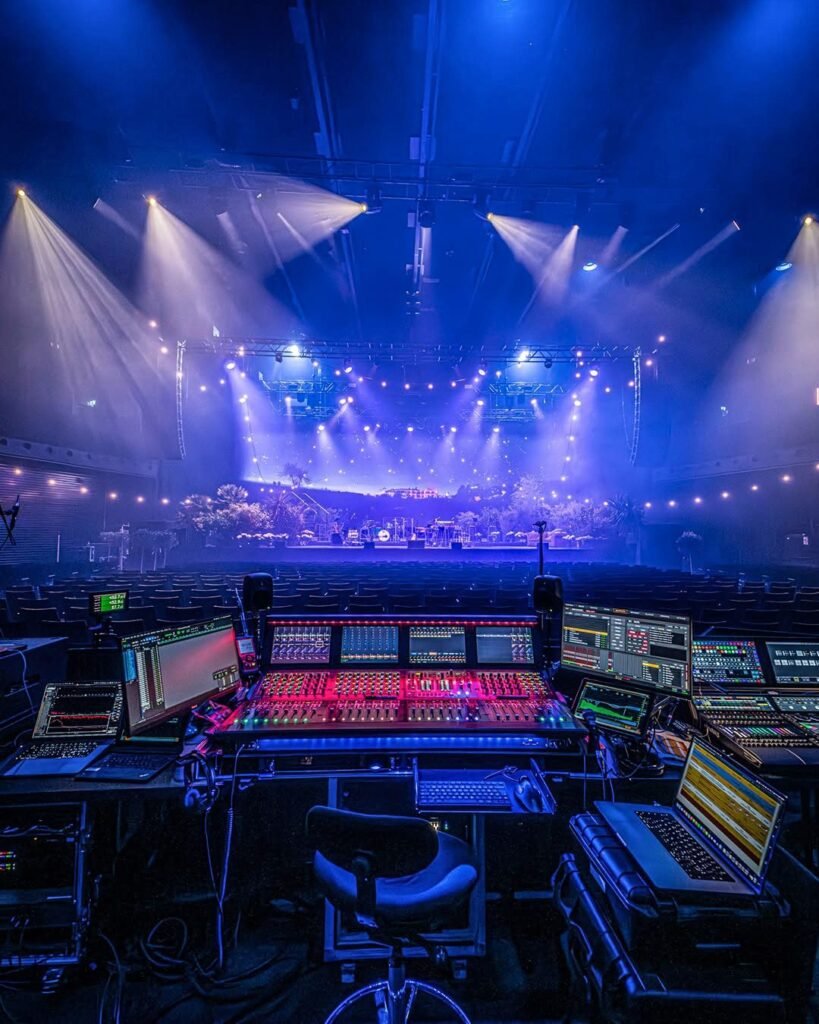
Stage and Venue Assessment
Before designing the lighting system, production teams evaluate:
- Stage dimensions
- Ceiling height
- Rigging capacity
- Audience size
- Power availability
- Indoor or outdoor environment
- Local safety regulations
- Camera and broadcast requirements
This information determines the number and type of fixtures required for each performance.
Selecting the Right Lighting Fixtures
Professional touring rigs typically combine several fixture types to maximize creative flexibility.
Moving Head Beam Lights
Beam fixtures create powerful aerial effects that remain visible over long distances.
They are commonly used for:
- Opening sequences
- Audience sweeps
- Festival performances
- High-energy musical moments
Moving Head Wash Lights
Wash fixtures provide broad, even illumination across performers and stage areas.
They serve as the primary source of stage lighting throughout the show.
Moving Head Spot Lights
Spot fixtures offer precision lighting and advanced creative features including:
- Gobo projection
- Motorized zoom
- Rotating prisms
- Focus adjustment
- Framing effects
They are ideal for highlighting performers and creating dramatic visual scenes.
LED Blinders and Audience Lights
Audience lighting helps create interaction between performers and spectators during key moments of the show.
LED blinders are commonly used during:
- Song climaxes
- Final choruses
- Encore performances
- Audience participation segments
LED Technology for Touring
Modern touring productions almost exclusively use LED fixtures because they offer:
- Lower energy consumption
- Reduced heat generation
- Longer operating life
- Lightweight construction
- Faster setup
- Lower maintenance requirements
LED technology also simplifies transportation by reducing the overall system weight.
Modular Truss Systems
Professional touring systems are built around modular truss structures.
Benefits include:
- Rapid assembly
- Flexible stage configurations
- Easy transportation
- Consistent fixture positioning
- Improved structural reliability
Pre-rigged trusses allow lighting fixtures to remain mounted during transportation, significantly reducing setup time.
Intelligent Lighting Control
Touring productions rely on advanced lighting control systems capable of managing hundreds of fixtures simultaneously.
Common technologies include:
- DMX512
- Art-Net
- sACN
- Lighting consoles
- Media servers
- Network switches
- Wireless DMX
These systems enable precise control of every fixture throughout the performance.
Timecode Synchronization
Large concert tours typically synchronize lighting with:
- Audio playback
- LED video walls
- Media servers
- Lasers
- Pyrotechnics
- Stage automation
Timecode ensures every lighting cue occurs at the exact programmed moment, delivering consistent performances at every venue.
Video and Multimedia Integration
Modern touring productions integrate lighting with:
- LED video walls
- Projection mapping
- Camera systems
- Live streaming
- Broadcast production
- Visual effects
Lighting and video operate together to create immersive multimedia experiences for audiences both in-person and online.
Power Distribution
Reliable electrical infrastructure is essential for touring productions.
Professional systems include:
- Power distribution units
- Backup power supplies
- Circuit protection
- Load balancing
- Power monitoring systems
Proper power management protects equipment while ensuring uninterrupted operation.
Transportation and Logistics
Touring lighting equipment must withstand constant travel.
Production companies use:
- Shock-resistant flight cases
- Custom storage solutions
- Cable management systems
- Labeling systems
- Inventory tracking
Efficient logistics reduce setup time and minimize equipment damage.
Backup and Redundancy
Professional tours prepare for unexpected equipment failures by maintaining:
- Backup lighting consoles
- Spare fixtures
- Duplicate show files
- Redundant network switches
- Secondary timecode systems
- Backup power supplies
Redundancy helps prevent interruptions during live performances.
Best Practices for Touring Lighting Design
Professional lighting designers recommend:
- Standardize fixture layouts across the tour.
- Use modular rigging systems.
- Label all cables and equipment.
- Prepare scalable lighting configurations.
- Test synchronization before every performance.
- Maintain backup systems.
- Schedule routine fixture maintenance.
These practices improve reliability and operational efficiency.
Common Design Mistakes
Avoid these common issues:
- Overloading truss systems
- Ignoring venue power limitations
- Insufficient backup equipment
- Poor cable organization
- Inconsistent fixture placement
- Inadequate rehearsal time
- Weak communication between production departments
Attention to detail helps ensure smooth touring operations.
Frequently Asked Questions
What lights are used on concert tours?
Professional tours typically use moving head beam lights, wash lights, spot fixtures, LED blinders, pixel-mapped fixtures, and LED video systems to create versatile lighting designs.
Why do touring productions use LED lighting?
LED fixtures consume less power, produce less heat, last longer, and weigh less than traditional lighting technologies, making them ideal for touring environments.
How do concert tours keep lighting consistent?
Lighting designers use standardized fixture layouts, timecode synchronization, programmed lighting cues, and identical control systems to reproduce the same show at every venue.
Why is timecode important on tour?
Timecode synchronizes lighting with audio, video, lasers, pyrotechnics, and automation, ensuring every performance remains accurate and repeatable.
How long does it take to set up a touring lighting system?
Setup time varies depending on production size. Smaller touring systems may take several hours, while large arena or stadium productions often require a full day or more, supported by experienced rigging and lighting crews.
Conclusion
Designing a touring concert lighting system requires careful planning, advanced technology, and efficient logistics. By combining intelligent LED fixtures, modular truss systems, DMX512 networks, timecode synchronization, multimedia integration, and reliable backup solutions, production teams can deliver consistent, visually stunning performances in venues around the world.
Whether you’re planning a regional concert tour, international festival circuit, theatre production, or arena show, investing in a professionally designed touring lighting system ensures flexibility, reliability, and unforgettable live entertainment experiences.