
Proper power planning is one of the most important aspects of designing a professional stage lighting system. Whether you’re installing lighting for a theatre, concert venue, church, television studio, conference center, school auditorium, or outdoor festival, accurately calculating your power requirements helps prevent overloaded circuits, voltage drops, equipment failures, and costly downtime.
Modern LED fixtures consume significantly less power than traditional stage lighting, but a professional lighting system still requires careful electrical planning to ensure safe and reliable operation.
In this guide, you’ll learn how to calculate stage lighting power requirements step by step, understand electrical terminology, and determine the correct power distribution for your lighting system.
Why Power Calculations Are Important
Accurate power calculations help you:
- Prevent overloaded electrical circuits
- Select the correct power distribution equipment
- Reduce voltage drop
- Improve electrical safety
- Protect expensive lighting fixtures
- Plan generator capacity for outdoor events
- Support future system expansion
- Comply with electrical regulations
Proper planning also makes troubleshooting much easier during live events.
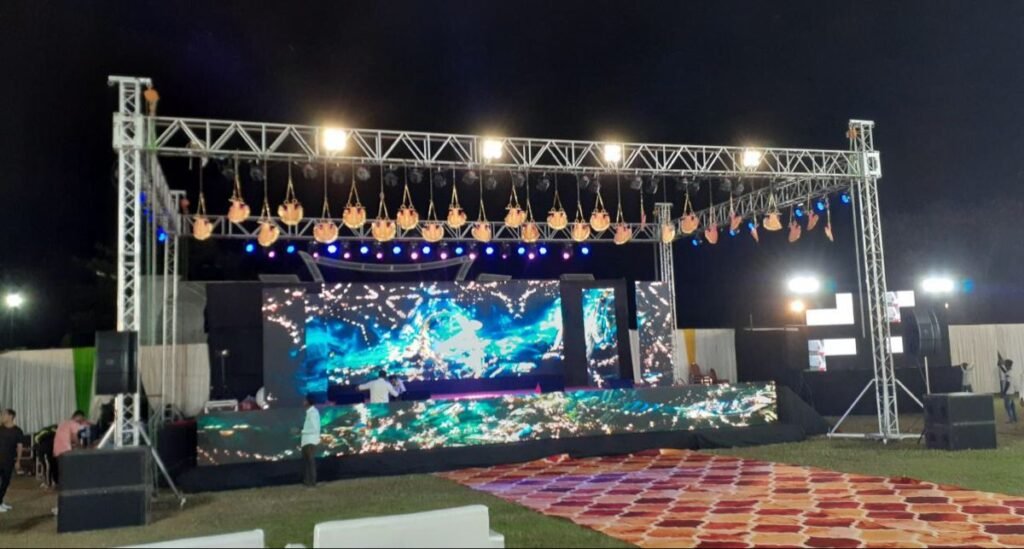
Step 1: Make a List of All Equipment
Begin by listing every device that requires electrical power.
Typical equipment includes:
- Moving head lights
- LED PAR lights
- Beam lights
- Wash lights
- Profile spotlights
- Fresnel fixtures
- LED battens
- Followspots
- Lighting consoles
- DMX nodes
- Network switches
- Media servers
- Haze or fog machines
Do not forget accessories that consume power.
Step 2: Find the Power Consumption
Every lighting fixture has a rated power consumption listed by the manufacturer.
Typical examples include:
| Equipment | Typical Power Consumption |
|---|---|
| LED PAR Light | 100–250 W |
| Moving Head Spot | 300–700 W |
| Moving Head Beam | 250–500 W |
| LED Wash Light | 200–600 W |
| Profile Fixture | 250–800 W |
| Followspot | 500–1,500 W |
| Lighting Console | 50–200 W |
| Network Switch | 20–100 W |
Always use the manufacturer’s published specifications when available.
Step 3: Calculate Total Power
Multiply the number of fixtures by the power consumption of each fixture.
Example
| Equipment | Quantity | Power | Total |
|---|---|---|---|
| Moving Head Spot | 12 | 450 W | 5,400 W |
| LED PAR | 24 | 180 W | 4,320 W |
| LED Battens | 8 | 150 W | 1,200 W |
| Lighting Console | 1 | 150 W | 150 W |
| Network Equipment | 2 | 50 W | 100 W |
Total Power = 11,170 Watts
This is the estimated maximum power requirement for the lighting system.
Step 4: Convert Watts to Current (Amps)
Electrical circuits are usually sized by current (amps) rather than watts.
For single-phase systems, use:
Current (A) = Power (W) ÷ Voltage (V)
Example (230V Supply)
- Total Power = 11,170 W
- Supply Voltage = 230 V
Current = 11,170 ÷ 230 = 48.6 A
Example (120V Supply)
- Total Power = 11,170 W
- Supply Voltage = 120 V
Current = 11,170 ÷ 120 = 93.1 A
Knowing the current draw helps determine the number and size of circuits required.
Step 5: Add a Safety Margin
Professional electrical systems should not operate continuously at maximum capacity.
A common recommendation is to leave 20–25% spare capacity for:
- Startup current
- Temporary equipment
- Future expansion
- Unexpected load increases
For example:
- Calculated Load: 11.2 kW
- Recommended Capacity: 14 kW
This reserve improves reliability and reduces the risk of breaker trips.
Step 6: Divide the Load Across Circuits
Never connect every fixture to one electrical circuit.
Instead:
- Balance fixtures across multiple circuits.
- Separate high-power fixtures from low-power equipment.
- Avoid exceeding the rated capacity of any breaker.
- Group fixtures logically by truss or stage area.
Balanced loads improve electrical stability and simplify troubleshooting.
Step 7: Consider Three-Phase Power
Large venues often use three-phase electrical distribution.
Benefits include:
- Higher available power
- Better load balancing
- Reduced cable size
- Improved efficiency
For large concerts, festivals, and permanent venues, three-phase systems are often the preferred solution.
Step 8: Calculate Generator Size (Outdoor Events)
If using a generator, choose one with enough capacity for:
- Total lighting load
- Audio systems
- Video equipment
- LED screens
- Production equipment
- Spare capacity
A generator should not operate continuously at 100% of its rated output.
Allow additional capacity to ensure stable voltage and reliable operation.
Step 9: Plan for Future Expansion
Many venues expand their lighting systems over time.
Leave room for:
- Additional fixtures
- Extra circuits
- More DMX universes
- Network equipment
- Media servers
Planning ahead avoids expensive electrical upgrades later.
Example Power Calculation
| Equipment | Qty | Watts Each | Total Watts |
|---|---|---|---|
| Moving Head Spot | 16 | 400 | 6,400 |
| LED PAR | 20 | 180 | 3,600 |
| LED Wash | 8 | 300 | 2,400 |
| LED Battens | 6 | 150 | 900 |
| Lighting Console | 1 | 150 | 150 |
| Network Equipment | 2 | 50 | 100 |
Total Connected Load: 13,550 Watts (13.55 kW)
At 230V:
- 13,550 ÷ 230 = 58.9 A
Adding a 20% reserve:
- Recommended supply capacity: approximately 16.3 kW
Common Mistakes to Avoid
Avoid these common power planning errors:
- Ignoring equipment specifications
- Forgetting accessories and control equipment
- Overloading circuits
- Choosing undersized generators
- Ignoring voltage drop
- Using cables that are too small
- Failing to leave spare capacity
- Skipping load balancing
- Not planning for future expansion
Careful calculations reduce equipment failures and improve system reliability.
Frequently Asked Questions
How do I calculate the total power required for stage lighting?
Add together the wattage of every powered device in the system, including lighting fixtures, consoles, networking equipment, and accessories. This gives the total connected load.
Why should I leave spare electrical capacity?
A spare capacity of 20–25% helps accommodate startup currents, future equipment, and temporary additions while reducing the risk of overloaded circuits and breaker trips.
Should LED stage lights still require power calculations?
Yes. Although LED fixtures are much more energy-efficient than traditional lighting, professional installations can still consume several kilowatts of power. Accurate calculations remain essential for safe operation.
How do I convert watts to amps?
Divide the total wattage by the supply voltage:
- Amps = Watts ÷ Volts
For example, a 4,600 W load on a 230 V supply draws approximately 20 A.
Do outdoor events require different power planning?
Yes. Outdoor events often rely on generators, temporary power distribution, and weatherproof equipment. Generator sizing, cable routing, and environmental protection should all be considered during the planning process.
Conclusion
Calculating stage lighting power requirements is a fundamental step in designing a safe, reliable, and efficient lighting system. By listing all powered equipment, calculating the total connected load, converting watts to current, balancing circuits, and allowing spare capacity, you can build an electrical system that supports consistent performance while protecting valuable equipment.
Whether you’re designing lighting for a theatre, church, broadcast studio, concert venue, conference center, school auditorium, or outdoor festival, accurate power calculations help ensure every event runs smoothly and safely.