
Moving head lights are among the most advanced and widely used fixtures in professional stage lighting. From concerts and theaters to churches, television studios, nightclubs, and corporate events, moving head lights create dynamic visual effects that traditional static fixtures cannot achieve.
Their ability to move, change colors, project patterns, and synchronize with music makes them a core component of modern lighting design.
In this guide, we’ll explain how moving head lights work, the key components inside these fixtures, and why they have become essential tools for lighting professionals worldwide.
What Is a Moving Head Light?
A moving head light is an intelligent lighting fixture that can automatically move in multiple directions while producing programmable lighting effects.
Unlike traditional stage lights that remain fixed in one position, moving head fixtures can rotate and tilt under electronic control.
Most moving head lights can perform:
- Pan movements
- Tilt movements
- Color changes
- Gobo projections
- Beam shaping
- Dimming
- Strobe effects
These capabilities allow a single fixture to create countless lighting effects.
The Main Components of a Moving Head Light
Understanding the internal components helps explain how these fixtures operate.
Light Source
Every moving head light contains a light source that generates illumination.
Common light sources include:
- LED light engines
- High-power discharge lamps
- Hybrid light sources
Modern fixtures increasingly use LED technology because of its efficiency, long lifespan, and color capabilities.
Optical System
The optical system shapes and controls the light output.
This section may include:
- Lenses
- Reflectors
- Focus mechanisms
- Zoom systems
The optical components determine beam angle, projection quality, and overall light performance.
Pan and Tilt Motors
Pan and tilt motors are responsible for movement.
Pan Movement
Pan refers to horizontal rotation.
Most moving head fixtures offer:
- 540° pan
- 630° pan
- Continuous rotation in advanced models
Tilt Movement
Tilt refers to vertical movement.
Most fixtures provide:
- 180° tilt
- 270° tilt
Together, pan and tilt allow the fixture to direct light almost anywhere within the venue.
How DMX Controls Moving Head Lights
Moving head lights are typically controlled using DMX512.
DMX is a digital communication protocol that sends commands from a controller to lighting fixtures.
DMX allows operators to control:
- Movement
- Colors
- Brightness
- Gobos
- Strobe effects
- Zoom functions
Every fixture is assigned a DMX address, allowing individual or grouped control.
Understanding DMX Channels
Each moving head light uses multiple DMX channels.
Examples include:
| Function | DMX Channel |
|---|---|
| Pan | Channel 1 |
| Tilt | Channel 2 |
| Dimmer | Channel 3 |
| Color Wheel | Channel 4 |
| Gobo Wheel | Channel 5 |
| Focus | Channel 6 |
| Zoom | Channel 7 |
Advanced fixtures may use dozens of DMX channels for expanded control.
How Color Changes Work
Modern moving head lights can produce multiple colors.
LED Fixtures
LED moving heads use RGB or RGBW color mixing systems.
These systems combine:
- Red LEDs
- Green LEDs
- Blue LEDs
- White LEDs
By adjusting intensity levels, the fixture can create millions of color combinations.
Color Wheel Systems
Some fixtures use physical color wheels containing pre-installed color filters.
The fixture rotates the wheel to change colors instantly.
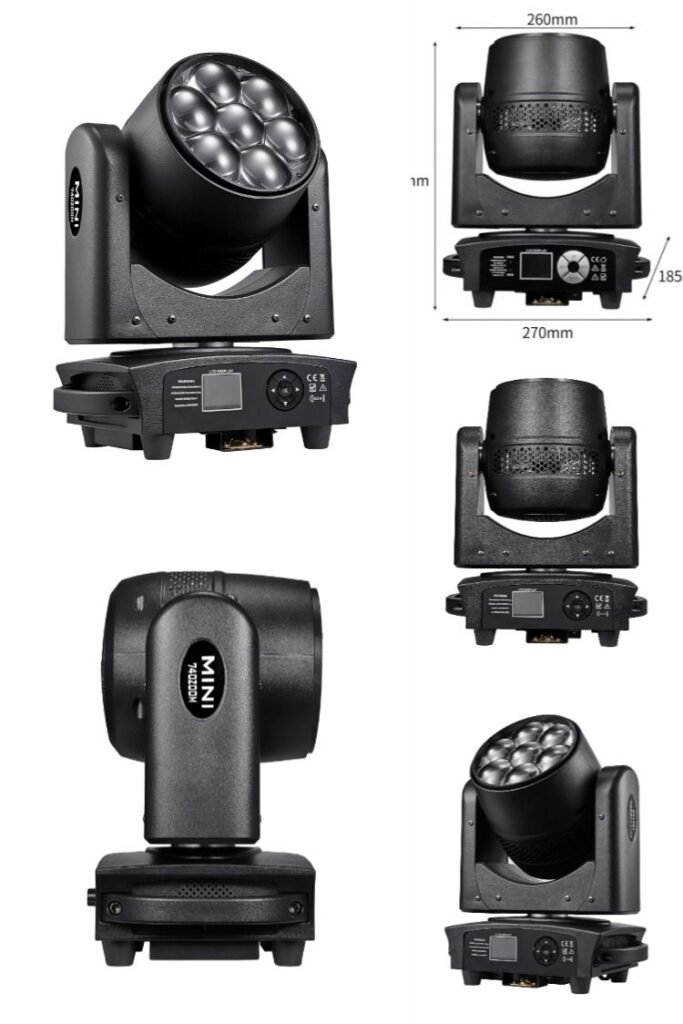
How Gobo Projection Works
Many moving head lights include gobos.
A gobo is a small metal or glass pattern inserted into the light path.
Common gobo effects include:
- Logos
- Geometric patterns
- Textures
- Abstract effects
The fixture projects the pattern onto stages, walls, floors, or scenery.
This feature is especially common in spot moving head lights.
How Beam Angles Are Controlled
Beam angle determines how wide or narrow the light output appears.
Moving head lights may offer:
Fixed Beam Angles
Common in beam fixtures.
Adjustable Zoom Systems
Common in spot and wash fixtures.
Zoom systems allow operators to adjust coverage based on venue requirements.
How Strobe Effects Work
Moving head fixtures often include strobe functions.
The fixture rapidly turns the light source on and off to create flashing effects.
Strobes are frequently used during:
- Concerts
- Festivals
- Nightclubs
- Special effects sequences
The speed and intensity can usually be adjusted through DMX control.
How Moving Head Lights Create Effects
Modern fixtures combine multiple technologies simultaneously.
Examples include:
Beam Effects
Narrow, high-intensity aerial beams.
Gobo Effects
Projected patterns and textures.
Prism Effects
Multiple beam splitting effects.
Color Effects
Dynamic color transitions and color chases.
Motion Effects
Automated movement sequences synchronized with music or programming.
These capabilities allow lighting designers to create highly dynamic shows.
Types of Moving Head Lights
Beam Moving Head Lights
Designed for:
- Long-distance projection
- Aerial effects
- Sharp beams
Commonly used in concerts and festivals.
Spot Moving Head Lights
Designed for:
- Gobo projection
- Focused illumination
- Visual effects
Popular in theaters and corporate events.
Wash Moving Head Lights
Designed for:
- Wide coverage
- Color washes
- Background lighting
Frequently used in churches, stages, and event venues.
Hybrid Moving Head Lights
Combine:
- Beam functions
- Spot functions
- Wash functions
These fixtures provide maximum versatility.
Why Moving Head Lights Are Popular
Modern productions use moving heads because they offer:
- Multiple effects from one fixture
- Reduced equipment requirements
- Flexible programming
- Dynamic visual experiences
- Professional production value
A small number of moving heads can replace numerous traditional fixtures.
Common Applications
Moving head lights are used in:
- Concert lighting
- Theater productions
- Church lighting
- Television studios
- Corporate events
- Festivals
- Nightclubs
- Broadcast productions
Their versatility makes them suitable for virtually any professional lighting environment.
Frequently Asked Questions
What is a moving head light?
A moving head light is an intelligent lighting fixture capable of automated movement, color changes, pattern projection, and programmable effects.
How do moving head lights move?
Internal pan and tilt motors rotate the fixture horizontally and vertically.
What controls moving head lights?
Most professional fixtures are controlled using DMX512 lighting control systems.
What are gobos in moving head lights?
Gobos are metal or glass patterns that can be projected through the fixture to create logos, textures, and visual effects.
What is the difference between beam, spot, and wash moving heads?
Beam fixtures create narrow aerial beams, spot fixtures project patterns and focused light, while wash fixtures provide wide and even illumination.
Conclusion
Moving head lights combine advanced optics, electronic controls, motors, and intelligent programming to create some of the most impressive effects in modern lighting design. Their ability to move, change colors, project patterns, and adapt to different environments makes them essential tools for professional productions.
Whether used in concerts, theaters, churches, television studios, or corporate events, moving head lights continue to play a central role in creating engaging and memorable visual experiences.